
How to Use an Abacus: Soroban Basics for Beginners
The abacus has been used for centuries as a reliable tool for arithmetic. While different cultures developed their own versions, the Japanese soroban remains one of the most refined and widely practiced today. With its simple 1:4 bead design, the soroban combines tradition, elegance, and efficiency. In this guide, we’ll explore how to use the soroban, the techniques that make it powerful, and why it remains relevant in modern education.
Japanese Soroban vs. Chinese Suanpan
Two main types of abacus dominate worldwide use. While both work on the same principle of moving beads to represent numbers, they differ in design and feel.
| Feature | Japanese Soroban | Chinese Suanpan |
|---|---|---|
| Bead Layout | 1 above, 4 below | 2 above, 5 below |
| Typical Size | Slim, compact | Larger frame |
| Ease of Use | Simple and fast, ideal for teaching | Versatile but more complex |
| Popularity | Common in schools, exams, and mental math | Traditional tool, still used in some regions |
| Calculation Focus | Streamlined for arithmetic (add/sub/multiply/divide) | Supports broader calculations like roots/fractions |
Structure of the Soroban
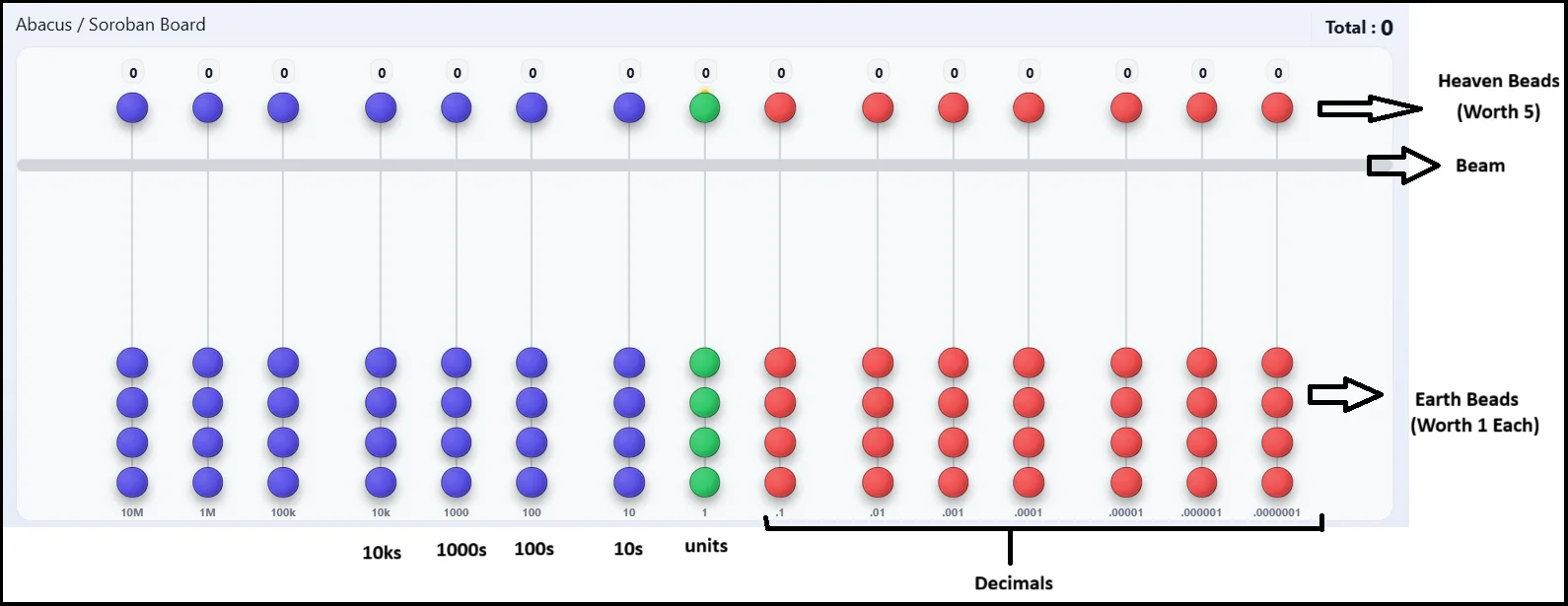
- Frame and rods – vertical rods hold the sliding beads.
- Beam (reckoning bar) – separates heaven beads (above) from earth beads (below).
- Heaven beads – each worth 5.
- Earth beads – each worth 1.
- Unit rods – every third rod has a marker dot, making it easier to identify place values (ones, tens, hundreds, etc.).
Example: If rod H is chosen as the unit rod, the number 54,321 is placed so each digit sits on the correct rod. The “1” falls neatly on the unit rod, keeping place values aligned.
How to Set Numbers on a Soroban
- Use thumb to push earth beads up.
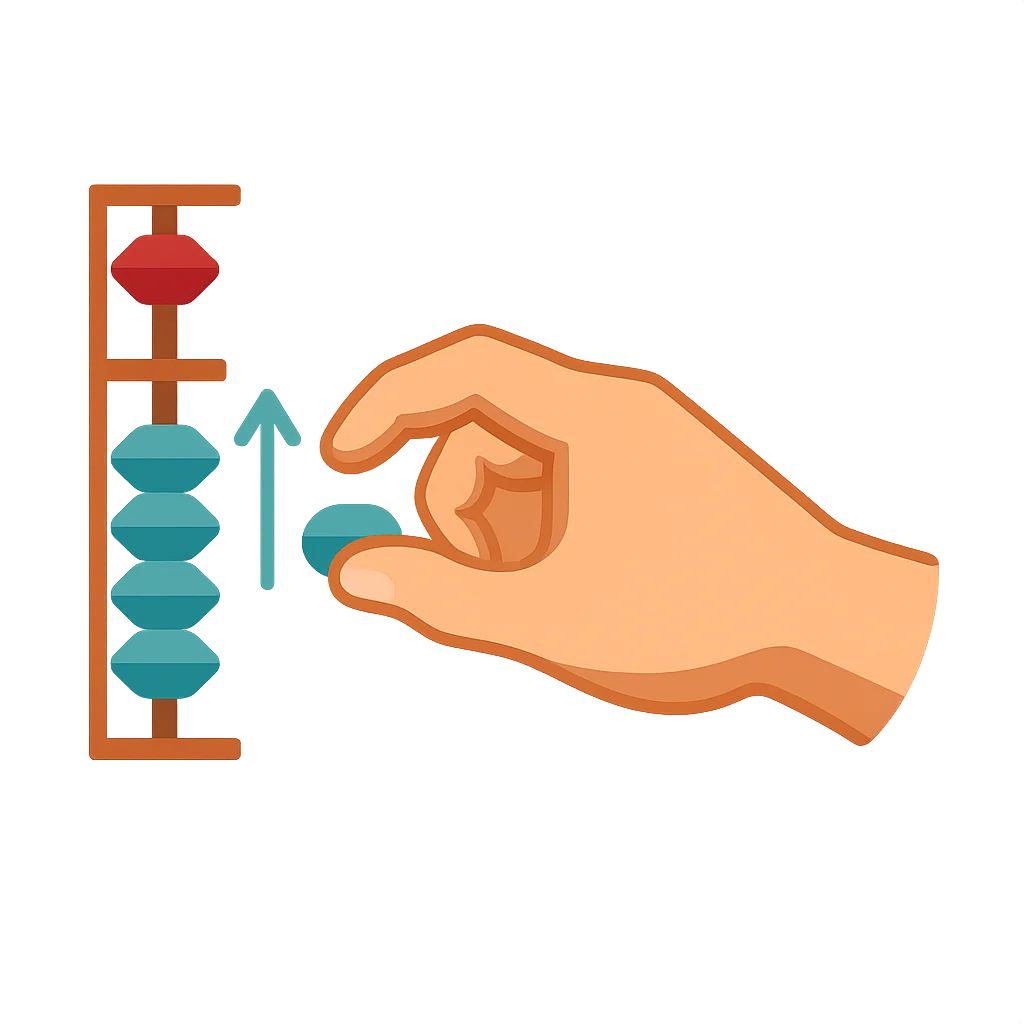
Earth beads up - Use index finger to move heaven beads down or push earth beads away from the beam.
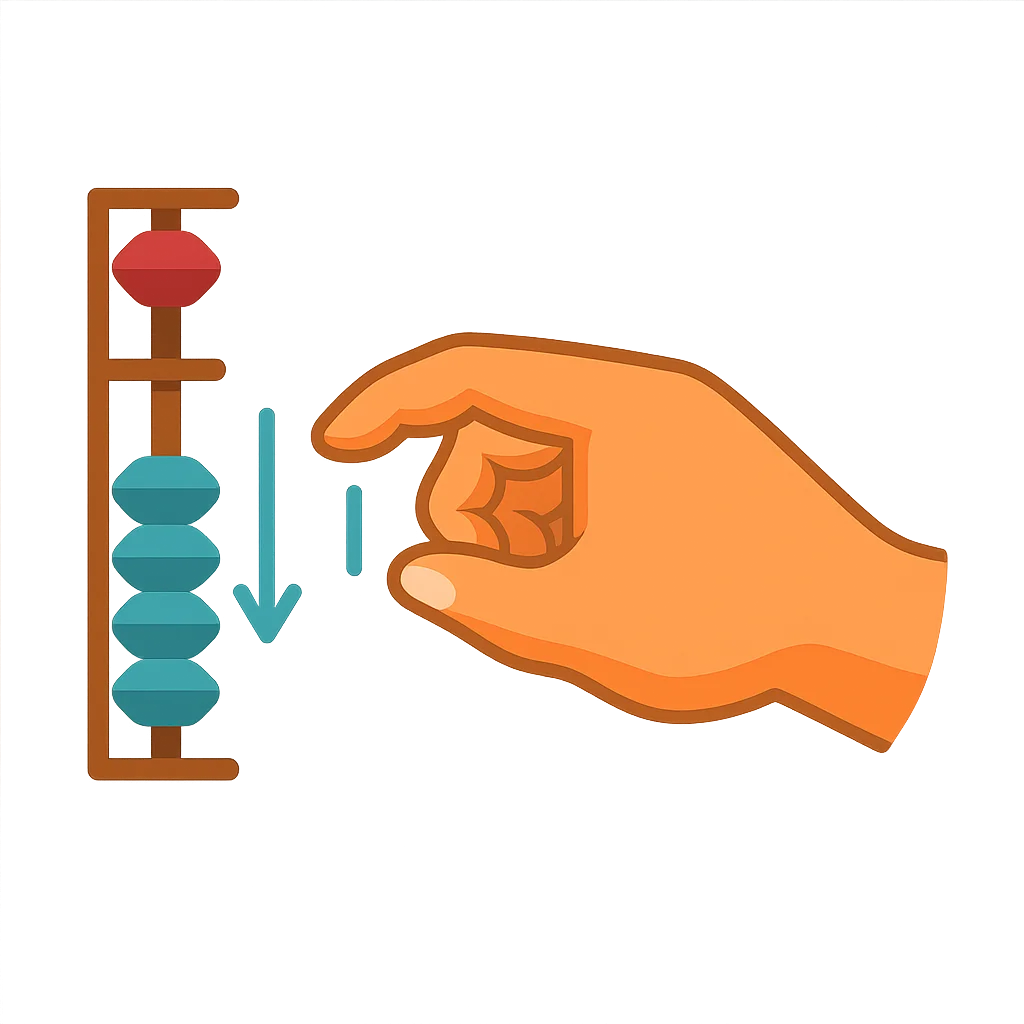
Earth beads down
Examples:
- 2 = two earth beads up.
- 5 = one heaven bead down.
- 9 = one heaven bead down + four earth beads up.
Clearing the Soroban
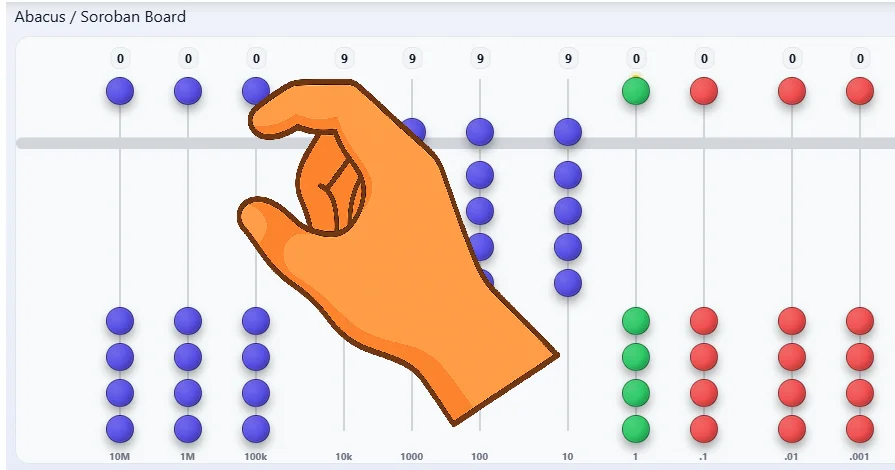
- Tilt the frame slightly toward you so beads fall away from the beam.
- Sweep the back of your index finger across the beam to push all heaven beads up.
A cleared soroban ensures no accidental values remain.
Rule #1: Always Work Left to Right
One of the biggest strengths of the soroban is its left-to-right calculation process — the same way we read and hear numbers.
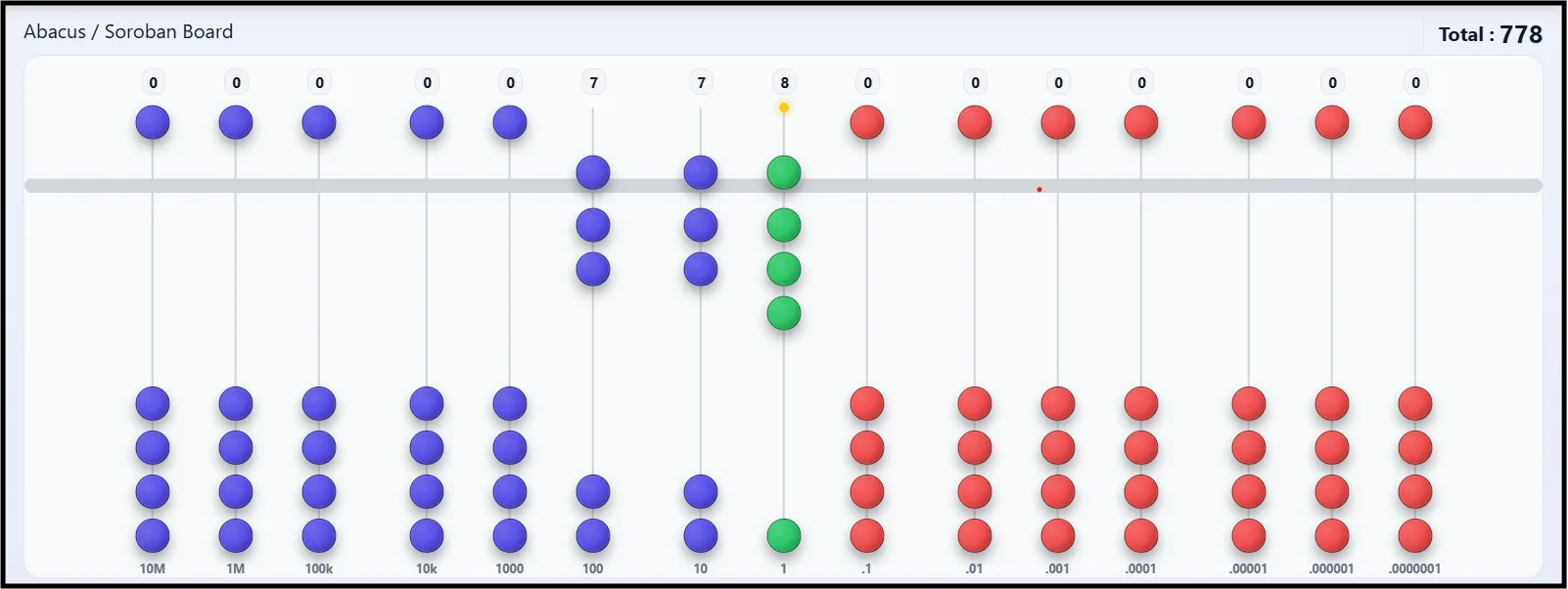
Example (Addition): To solve 452 + 326, set 452 first, then add 3 to the hundreds rod, 2 to the tens rod, and 6 to the units rod → 778.
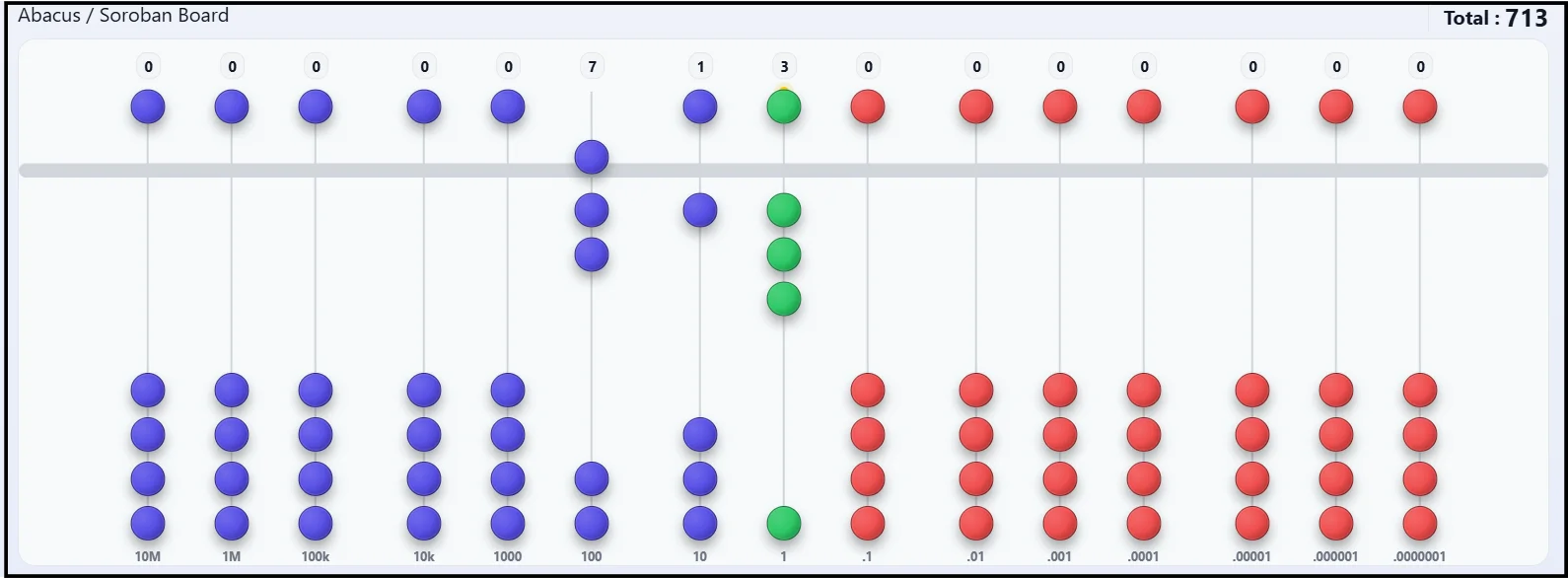
Example (Subtraction): For 961 – 248, set 961, subtract 2 from the hundreds rod, 4 from the tens rod, and 8 from the units rod → 713.
Complementary Numbers: The Secret to Speed
When a rod doesn’t have enough beads for direct addition or subtraction, complements come into play.
Complements of 5: (4 & 1), (3 & 2).
Complements of 10: (9 & 1), (8 & 2), (7 & 3), (6 & 4), (5 & 5).
Example – Addition: 7 + 8 = 15
Place 7. Subtract the complement (2) and carry 1 to the next rod. Result = 15.
Example – Subtraction: 23 – 9 = 14
Place 23. Subtract 10 and then add the complement (1). Result = 14.
Order of Operations on the Rods
- Addition: Subtract the complement on the current rod, then carry over to the left rod.
- Subtraction: Borrow from the left rod, then add the complement on the current rod.
This prevents wasted movements and keeps calculations efficient.
Combining Finger Movements
To save time, advanced users combine thumb and index movements:
- 6 + 9 = 15 – Done in two swift motions instead of four.
- 18 + 7 = 25 – Combine bead setting and clearing.
- 32 – 18 = 14 – Replace multiple small steps with one smooth movement.
Abacus Exams and Professional Use in Japan
In the 20th century, the Japan Chamber of Commerce and Industry established an Abacus Committee to certify professional operators.
- Exams ranged from 10th grade (beginner) to 1st grade (expert).
- Candidates had to solve long lists of problems under time limits.
- Only top-grade passers (1st–3rd) were eligible for government and business roles.
This history highlights how seriously soroban mastery was regarded.
Mechanization: The Process of Thoughtlessness
Instead of calculating mentally, soroban users rely on mechanical patterns of bead movements.
Example: Solving 746,529 is broken down digit by digit: 7, 4, 6, 5, 2, 9. Each is placed rod by rod, left to right, until the full number is built. With practice, movements become automatic—faster than a calculator.
Practice Exercises
Simple Addition
- 134 + 265 = ?
- 589 + 347 = ?
- 712 + 198 = ?
Simple Subtraction
- 643 – 217 = ?
- 980 – 456 = ?
- 432 – 289 = ?
Complementary Addition
- 8 + 7 = ?
- 9 + 6 = ?
- 7 + 8 = ?
Complementary Subtraction
- 21 – 8 = ?
- 34 – 9 = ?
- 53 – 7 = ?
Try solving them rod by rod, left to right, applying complements where needed. Over time, you’ll notice your fingers move automatically.
Why Soroban Remains Relevant
- Mental math training – Encourages visualization and memory.
- Speed and accuracy – With practice, faster than a calculator.
- Educational value – Improves concentration and number sense.
- Cultural heritage – Many soroban are handcrafted, carrying history and artistry.
Final Thoughts
The Japanese soroban is more than just a calculating tool—it’s a bridge between tradition and modern learning. By practicing complementary numbers, left-to-right operations, and combined finger movements, anyone can unlock lightning-fast calculation skills. Whether for education, competition, or simply the joy of mastering a timeless skill, the abacus remains a powerful tool in today’s world.